 the State Historical Society of Missouri
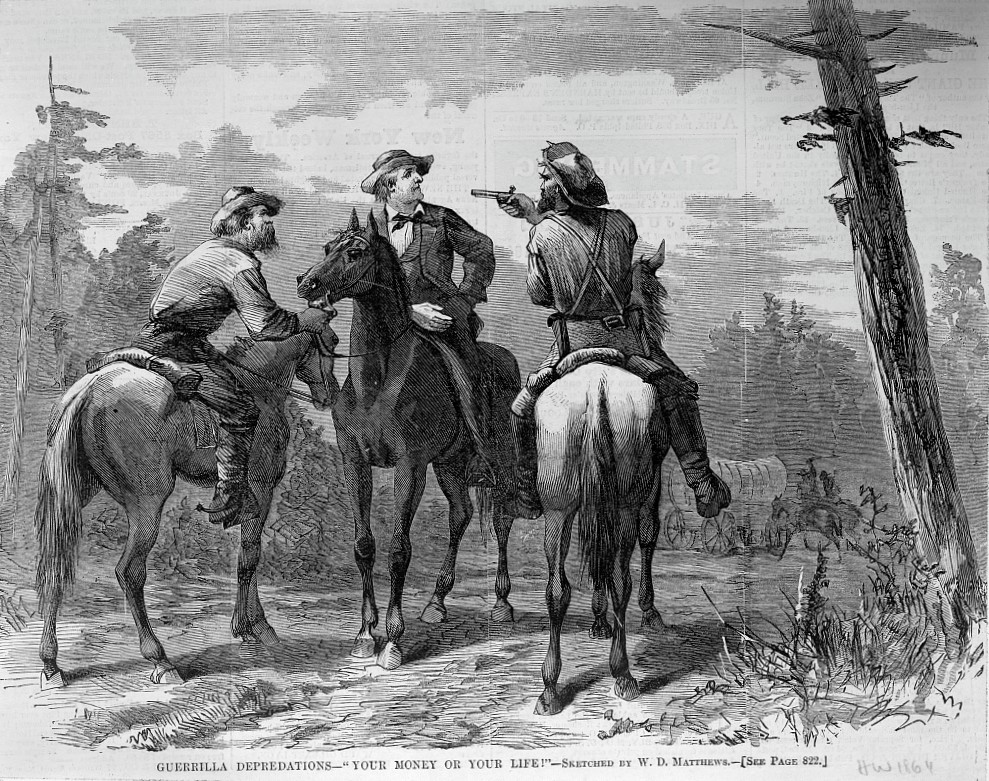
![Guerrillas in 1864. [Library of Congress, LC-USZ62-138113]](/sites/default/files/styles/article_header_image/public/2026-09/guerrilla-depredations-1864-harpers-weekly-lc-usz62-138113_0.jpg?itok=XhJg95_T "Guerrillas in 1864. [Library of Congress, LC-USZ62-138113]")
Born around 1839 in Bourbon County, Kentucky, James Jackson, more commonly known as Jim Jackson, came of age in Kentucky before moving to Texas prior to the Civil War. One contemporary account described him as just over six feet tall, dark complected, and freckled. At the outbreak of the war Jackson enlisted in the Confederate Texas Rangers. However, in Tennessee he killed a fellow soldier, prompting him to flee and join a calvary regiment led by John Hunt Morgan. During a raid in Ohio, Jackson was captured and taken to Camp Douglas, a Union prison camp near Chicago. Following his escape in the spring of 1864, Jackson moved to Missouri where he joined bushwhacker Clifton Holtzclaw.
During the Civil War Jackson became one of “Missouri’s more notorious Confederate guerrilla commanders.” Rising quickly through Holtzclaw’s command structure, Jackson became one of Holtzclaw’s lieutenants. He then joined a separate band with Joseph Gooch before becoming the leader of his own bushwhacker force. During his brief time in Missouri, Jackson earned a reputation as a daring combatant and notoriety for his brutality, particularly against free Black people whom he terrorized throughout the state. Jackson was known to frequently visit sympathetic Missouri widows; at the time of his death, he was carrying photographs of several different women.
In October of 1864 Jackson participated in a series of raids into Iowa in order to divert Union attention away from the Confederate invasion of Missouri that fall. Jackson then moved his operations squarely into Boone County, where he repeatedly fought with local Federal forces and carried out a campaign of terror against both white and Black people north of the Missouri River. He was particularly vicious against Black Missourians, and terrorized Black residents of Boone County, many of whom were elderly as well as women and children.
The winter of 1864–1865 was especially fraught with danger as Jackson terrorized Black Americans in the eastern part of the county, warning them to “leave the county by the 15th of February or they would all be killed; and notifying farmers that in case they hired negroes they too would be killed.” On January 20, 1865, Jackson made good on his threats when he lynched an elderly formerly enslaved man named Lewis, who at the time was living near his former master Dr. John W. Jacob. Jackson not only murdered the man, but left a note pinned to the victim’s lifeless body that stated, “Killed for knot [sic] going into the federal arms by order of Jim Jackson.” His efforts ultimately led many rural African Americans to seek safety in towns such as Columbia and Rocheport. Three weeks after the war ended, Jackson and three men robbed a stagecoach on which Congressman James S. Rollins was a passenger, further enraging local residents. By the war’s end Jackson was blamed for violence in Audrain, Boone, Callaway, Chariton, Howard, and Randolph counties.
On June 13, 1865, Jackson rode into Camp Switzer north of Columbia dressed “in full guerrilla regalia” and holding a white flag of surrender. He and several of members of his band swore allegiance to the federal government and were granted parole. Union authorities told Jackson he could leave the state. However, Jackson did not leave right away, but eventually made his way toward Illinois, hoping to escape the reports of vengeance planned against him. He and another former bushwhacker, William Farley, were captured by Union militiamen near Spencerburg in Pike County before being taken to Santa Fe in Monroe County, a journey of more than thirty miles. An 1882 Boone County history noted that “a squad of Capt. Mitchell’s ‘Tigers’ from Mexico were sent to Santa Fe to ascertain who they were (for their citizen captors did not know them) and they were recognized.” Jackson was summarily executed on June 19, 1865, for his “wartime thievery and murder.” An account in the Missouri Statesman reported that before his execution Jackson declared, “I have fought, bled, and now I am about to die for my country.” Many Missourians saw Jackson’s execution as the conclusion of a period of terror and violence in central Missouri.
History of Boone County, Missouri. St. Louis: Western Publishing Company, 1882.
The History of Linn County, Missouri. Kansas City: Birdsall & Dean, 1882.
Astor, Aaron. Rebels on the Border: Civil War, Emancipation, and the Reconstruction of Kentucky and Missouri. Baton Rouge: Louisiana State University Press, 2012.
Beilein Jr., Joseph M. Bushwhackers: Guerilla Warfare, Manhood, and the Household in Civil War Missouri. Kent, OH: The Kent State University Press, 2016.
Gerteis, Louis S. The Civil War in Missouri: A Military History. Columbia: University of Missouri Press, 2012.
Hulbert, Matthew C. “The Death of Jim Jackson and the Oxymoron of ‘Postbellum’ Missouri, 1865-1866,” The Civil War Monitor.
Nichols, Bruce. Guerrilla Warfare in Civil War Missouri, Volume IV, September 1864-June 1865. Jefferson, NC: McFarland & Co., 2014.
Phillips, Christopher. Missouri’s Confederate: Claiborne Fox Jackson and the Creation of Southern Identity in the Border West. Columbia: University of Missouri Press, 2008.
Published September 17, 2026; Last updated September 22, 2026
Creative Commons Attribution-NonCommerical-ShareAlike 4.0 International (CC BY-NC-SA 4.0)