 the State Historical Society of Missouri
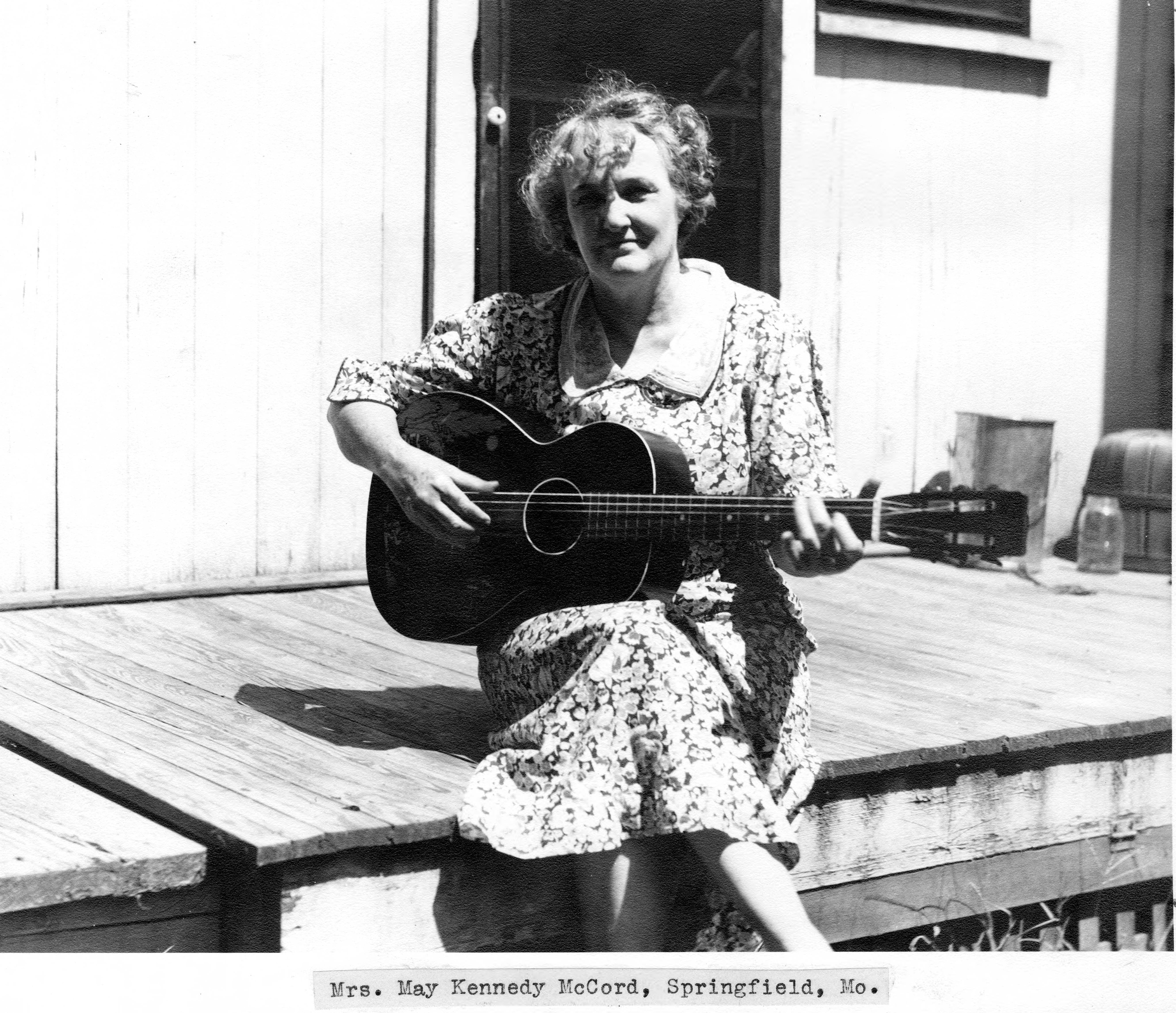
![May Kennedy McCord. [State Historical Society of Missouri, Vance Randolph Ozark Folksongs Collection, C3774]](/sites/default/files/styles/article_header_image/public/2026-06/mkm-vance-randolph-ozark-folksongs-collection-c3774.jpg?itok=ZA29v5c3 "May Kennedy McCord. [State Historical Society of Missouri, Vance Randolph Ozark Folksongs Collection, C3774]")
May Kennedy McCord was an Ozark folklorist, writer, musician, and radio personality whose work helped preserve and popularize the culture and traditions of the Ozarks during the twentieth century. Known as the “Queen of the Hillbillies” and the “Lady of the Ozarks,” McCord became one of the best-known interpreters of Ozark life and identity. Through her writings and travels, she introduced audiences across the United States to the folk traditions, dialect, stories, and music of southern Missouri and the greater Ozarks.
McCord was born in Stone County, Missouri, in 1880. Her parents were originally from Illinois and came from an educated and middle-class background. She attended school in Galena, Missouri, before graduating from Sheldon’s Private College in Aurora, Missouri. She learned folk songs and ballads from local musicians and developed an early love for storytelling and poetry. According to later accounts, she often hid poems beneath rocks so classmates would not discover them. These early experiences shaped her lifelong interest in preserving Ozark traditions and sharing them with wider audiences.
Before entering public life, McCord married Charles C. McCord, a traveling salesman, and raised three children in Galena, Missouri. Like many women of her generation, she delayed pursuing a professional career while focusing on family life. Nevertheless, McCord eventually established herself as one of the Ozarks’ most recognizable public voices.
During the 1920s, McCord earned public attention through her writing. She was asked to contribute a humorous article to the Springfield News and Leader. Afterward, she wrote short pieces for local newspapers and frequently contributed to the publications of Otto Ernest Rayburn. The Springfield News and Leader subsequently sought McCord out to become a regular columnist, leading to the creation of her long-running “Hillbilly Heartbeats” column. The column quickly became popular throughout Missouri and the Ozarks. McCord filled its pages with stories of everyday life, folk sayings, humor, memories, songs, dialect expressions, and reflections on rural traditions. Readers from across the region wrote to McCord with stories of their own, transforming the column into a widely read celebration of Ozark identity and community life. In 1942, during the Golden Age of Radio, McCord’s career expanded when she was invited to host a program on KWK in St. Louis. The death of her husband the following year temporarily interrupted her broadcasting career. She returned to the airwaves in 1945, joining KWTO in Springfield, where she continued her radio program until 1963.
As her popularity grew, McCord traveled extensively throughout the United States. She appeared before historical societies, universities, civic organizations, festivals, and women’s clubs, where she discussed Ozark customs, language, and folklore. Audiences in cities such as New York and Los Angeles were fascinated by her presentations on the Ozarks and its people. Her growing national prominence was further recognized in 1934 when she served as chair of the National Folk Festival. Despite her national recognition, McCord remained closely tied to the region and continued participating in local gatherings and community events throughout her life.
Music played a major role in McCord’s work. Performing traditional ballads with guitar accompaniment, she viewed folk music as one of the clearest expressions of Ozark heritage and oral tradition. Many of the songs she performed had been learned in childhood and reflected the region’s storytelling traditions. Her performances helped preserve older ballads and introduced them to audiences outside of the Ozarks. Her contributions to folk music also extended beyond public performances. McCord recorded dozens of folk songs during her career, many of which are now preserved in the Library of Congress.
McCord also became widely associated with discussions of Ozark dialect and speech. Although she was not formally trained as a folklorist, she became one of the region’s best-known interpreters of Ozark culture. Like several folklorists of her era, she believed the Ozarks preserved older forms of the English language and expression. She frequently wrote and spoke about regional sayings and speech patterns, arguing that aspects of older English traditions had survived in the hills of southern Missouri and northern Arkansas. These ideas attracted significant public attention and contributed to growing national interest in Ozark folklore during the mid-twentieth century. Although this interpretation reflected a common belief among folklorists during the early twentieth century, modern linguists generally view Ozark English as a distinct regional dialect that evolved over time while retaining some older linguistic features.
Among McCord’s closest professional associates was folklorist Vance Randolph, a Kansas native and one of the leading collectors and interpreters of Ozark folklore. The two shared a strong commitment to preserving the region’s stories, music, dialect, and traditions. Randolph praised McCord’s work and encouraged her to publish collections of her writings, believing they would appeal to a broad audience. Both were involved in the Ozark Folklore Society, founded in 1949, with Randolph serving as president and McCord acting as one of the organization’s counselors. Together, they helped establish the Ozarks as an important center of American folklore studies.
Throughout much of her work, McCord expressed concern about the effects of modernization on the Ozarks. She frequently wrote nostalgically about older ways of life, including wagon travel, isolated communities, folk customs, and small-town traditions. Like many regional writers of her era, she often portrayed the Ozarks through a romantic lens, emphasizing the value of traditional culture and rural life. Her writings reflected a belief that modernization and external influences threatened the region’s character and independence. These ideas resonated with many readers during the Great Depression and the decades that followed, particularly as tourism, highways, and industrial growth transformed the Ozarks.
By the mid-twentieth century, McCord was one of Missouri’s best-known cultural figures. In 1950 the Springfield Leader and Press named McCord the “Missouri Mother of the Year,” reflecting both her popularity and her public image throughout the state. Although she became nationally recognized, she remained deeply devoted to the Ozarks and its traditions throughout her life.
McCord died on February 21, 1979, at the age of ninety-eight. Her work left a lasting influence on the preservation and popularization of Ozark folklore and regional identity. Through her writing, music, travels, and advocacy for Ozark traditions, she helped shape how generations of Americans understood the culture and history of the Missouri Ozarks.
McCord, May Kennedy. “Woe to Him Who Criticizes the Hillbilly.” Springfield News and Leader, August 6, 1933.
“May Kennedy McCord.” Society of Ozarkian Hillcrofters Audio Collection.
“She’s Filled With the Lore of Ozark Hill People.” St. Louis Post-Dispatch, July 26, 1942.
Sutliff, Kristene, and Patti McCord. “May Kennedy McCord: Queen of the Ozarks.” Interview. OzarksWatch Video Magazine.
Sutliff, Kristene, and Patti McCord, eds. Queen of the Hillbillies: Writings of May Kennedy McCord. Fayetteville: University of Arkansas Press, 2022.
Published June 26, 2026
Creative Commons Attribution-NonCommerical-ShareAlike 4.0 International (CC BY-NC-SA 4.0)