 the State Historical Society of Missouri

![Josephine Winslow Johnson. [Simon and Schuster, photo provided by the Johnson Estate]](/sites/default/files/styles/article_header_image/public/2025-12/1.-josephine-johnson.jpg?h=96864416&itok=u0dti5r- "Josephine Winslow Johnson. [Simon and Schuster, photo provided by the Johnson Estate]")
![The cover of Now in November. [Simon and Schuster]](/sites/default/files/styles/article_header_image/public/2025-12/2.-josephine-johnson.jpg?itok=qxTF5xpn "The cover of Now in November. [Simon and Schuster]")
![Josephine Johnson at the Bread Loaf Writers’ Conference, 1934. [Middlebury College, Special Collections, mnb_07-1934-01p]](/sites/default/files/styles/article_header_image/public/2025-12/3.-josephine-johnson.jpg?itok=PKpmdRKl "Josephine Johnson at the Bread Loaf Writers’ Conference, 1934. [Middlebury College, Special Collections, mnb_07-1934-01p]")
![A photo accompanying news coverage of Johnson’s second novel, Jordanstown. [St. Louis Post-Dispatch, April 11, 1937]](/sites/default/files/styles/article_header_image/public/2025-12/4.-josephine-johnson.jpg?itok=Sd2MlEHX "A photo accompanying news coverage of Johnson’s second novel, Jordanstown. [St. Louis Post-Dispatch, April 11, 1937]")
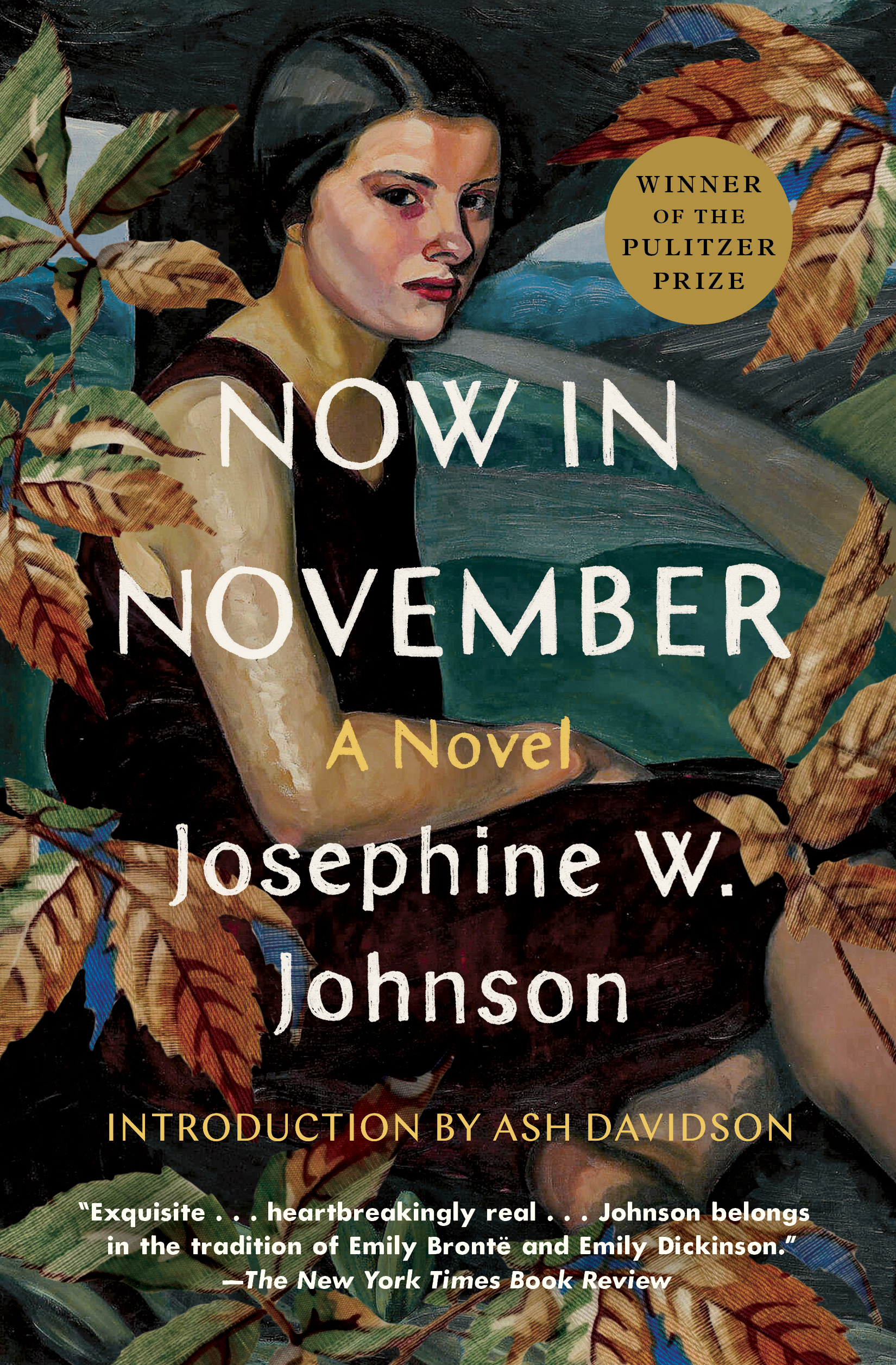
St. Louis writer and naturalist Josephine Johnson became the youngest winner of the Pulitzer Prize in fiction in 1935 for her book Now in November, set on a Missouri farm during the Great Depression. She was twenty-four years old. A native of Kirkwood, Missouri, Johnson spent part of her childhood on her grandfather’s nearby hundred-acre estate, a gentleman’s farm where she immersed herself in nature and began to write poetry at an early age. In her debut novel, Johnson portrayed life on a farm that contrasted sharply with her own experience, with themes of poverty, mental health, and human rights unfolding over the course of one year. Marget Haldmarne, the main character, is one of three sisters in a household facing environmental disasters from the Dust Bowl, fearful of homelessness and scraping by on mortgaged land. A New York Times book review described Johnson’s debut novel as “Exquisite . . . heartbreakingly real . . . Johnson belongs in the tradition of Emily Brontë and Emily Dickinson.”
Johnson’s narrative, reflecting on a full year of young Marget’s life, opens, “Now in November, I can see our years as a whole. This autumn is like both an end and a beginning to our lives, and those days which seemed confused with the blur of all things too near and familiar are clear and strange now.” In the book’s Part Two: The Long Drought, Johnson’s vivid imagery and lyrical prose evoke the Haldmarne family’s struggle to survive: “The creeks were dry rock-beds then, hot stones that sent up a quiver in the air. The ponds were holes cracked open and glazed with a drying mud. I kept hearing the calves bawl all the time, hot and thirsty in the pastures, but could only water them in the evenings.”
Many of the novel’s themes would also be explored by John Steinbeck in The Grapes of Wrath, published five years later. But unlike Steinbeck, who won the Pulitzer Prize for fiction in 1940, Johnson’s early fame diminished, and today her work is largely unknown. She wrote eleven books, including novels, short stories, and poetry, as well as articles for various periodicals. Born into a family of new wealth with humble immigrant beginnings, Johnson used her pen and voice to speak out on environmental and social justice causes, especially for the working class of her era.
In her 1973 book, Seven Houses: A Memoir of Time and Places, Johnson offers an autobiography built around the houses where she and her family lived and the natural world surrounding them. She was named after her maternal grandfather, Joseph Franklin, who immigrated to the United States in 1836 from County Cork, Ireland, and eventually rose to become vice president of the William Barr Dry Goods Company, a forerunner of Famous-Barr department stores in St. Louis. By 1883, Franklin had built an estate, Oakland, in St. Louis County near Kirkwood, where his family enjoyed comfortable country living. The family sold the home and land, and since 1915 it has been the site of Ursuline Academy, a Catholic college preparatory school for girls.
Josephine, the daughter of Ethel and Benjamin Johnson, was born on June 20, 1910. She and her three sisters attended a private school in Kirkwood, where Josephine became captivated hearing her teacher, Miss Blanche Byars, read out loud from The Voyages of Ulysses. “I listened. I was there. In that boat, on those waves,” wrote Johnson. “The south wind was for tomorrow’s reading. Ulysses tossed on the waves until Tuesday. I have never been in a classroom since where I watched the clock and hoped it would not strike the hour.”
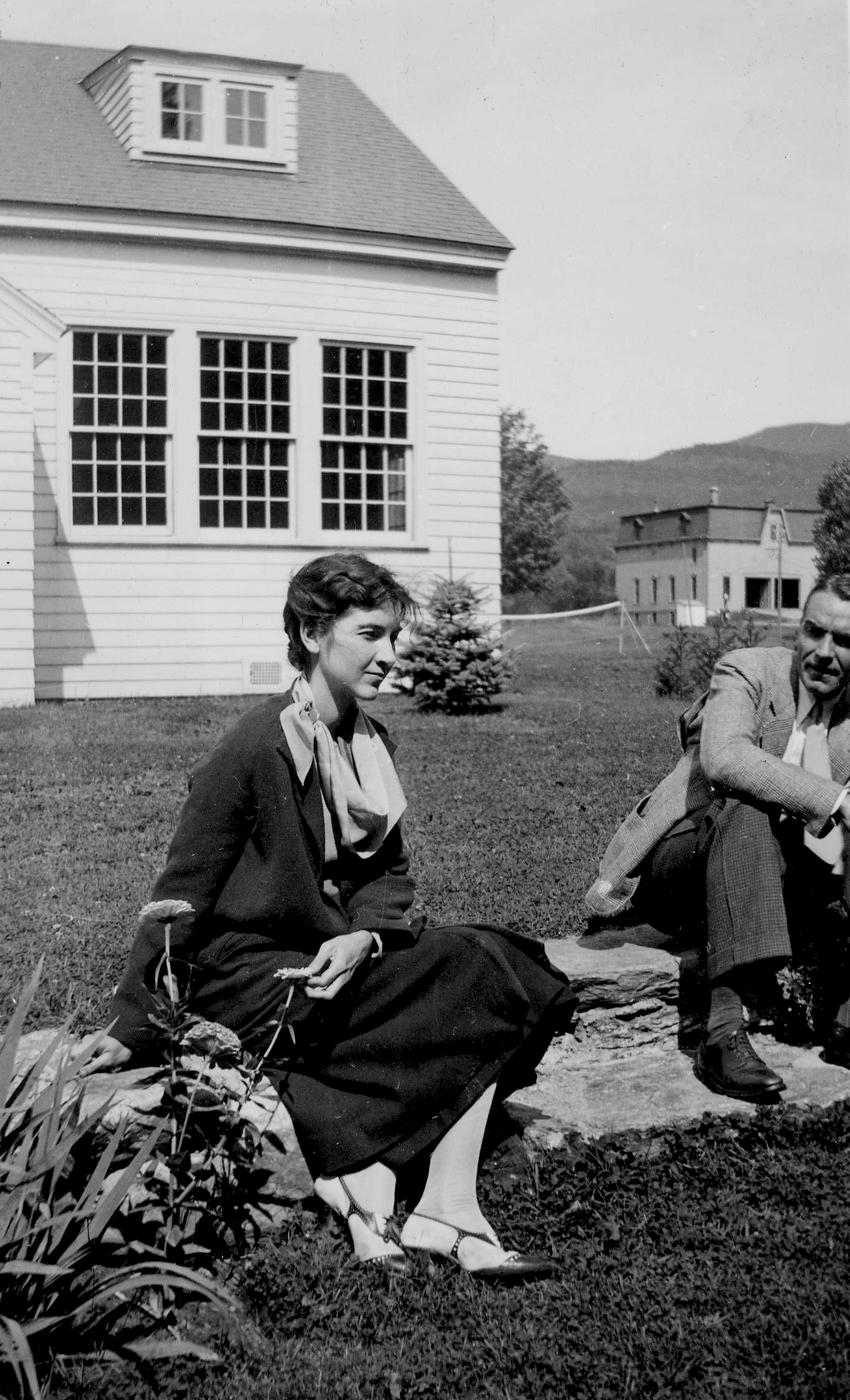
At seventeen, Johnson entered Washington University in St. Louis, a year after the death of her father from cancer. Finding solace in sketching and writing, she studied art and English. Johnson had success in publishing stories and poems, and caught the eye of Clifton Fadiman, an editor at Simon and Schuster. Fadiman contacted the twenty-one-year-old college student after reading one of her stories in the Atlantic Monthly. His letter praised her short story as “a beautiful piece of work. I would like to know more of your literary plans. It seems indicated that you are to be a writer.” Johnson began a long working relationship with Fadiman and the publishing company, including her first book contract for her Pulitzer Prize winner. Destined to be a writer, Johnson left college before graduating to continue working on her craft and her first novel-in-progress.
As a member of the St. Louis Writers’ Guild in the early 1930s, Johnson was asked to judge its short story contest. She awarded the prize to Tom Williams, a local aspiring writer. In a letter dated February 2, 1933, Williams thanked Johnson for the guild award, which he said took him by complete surprise: “It certainly gives me more encouragement than anything else I’ve achieved in writing thus far!” Williams’s story featured two characters, Jonathan and Stella, whom he described as representing “a good cross-section of my writing . . . full of bombastic irrelevancies, the characters aren’t logically developed, and the romantic spirit, like Stella’s garden, is almost unbearably sweet.” Adopting the pen name Tennessee Williams, he would go on to become one of the foremost American playwrights of the twentieth century.
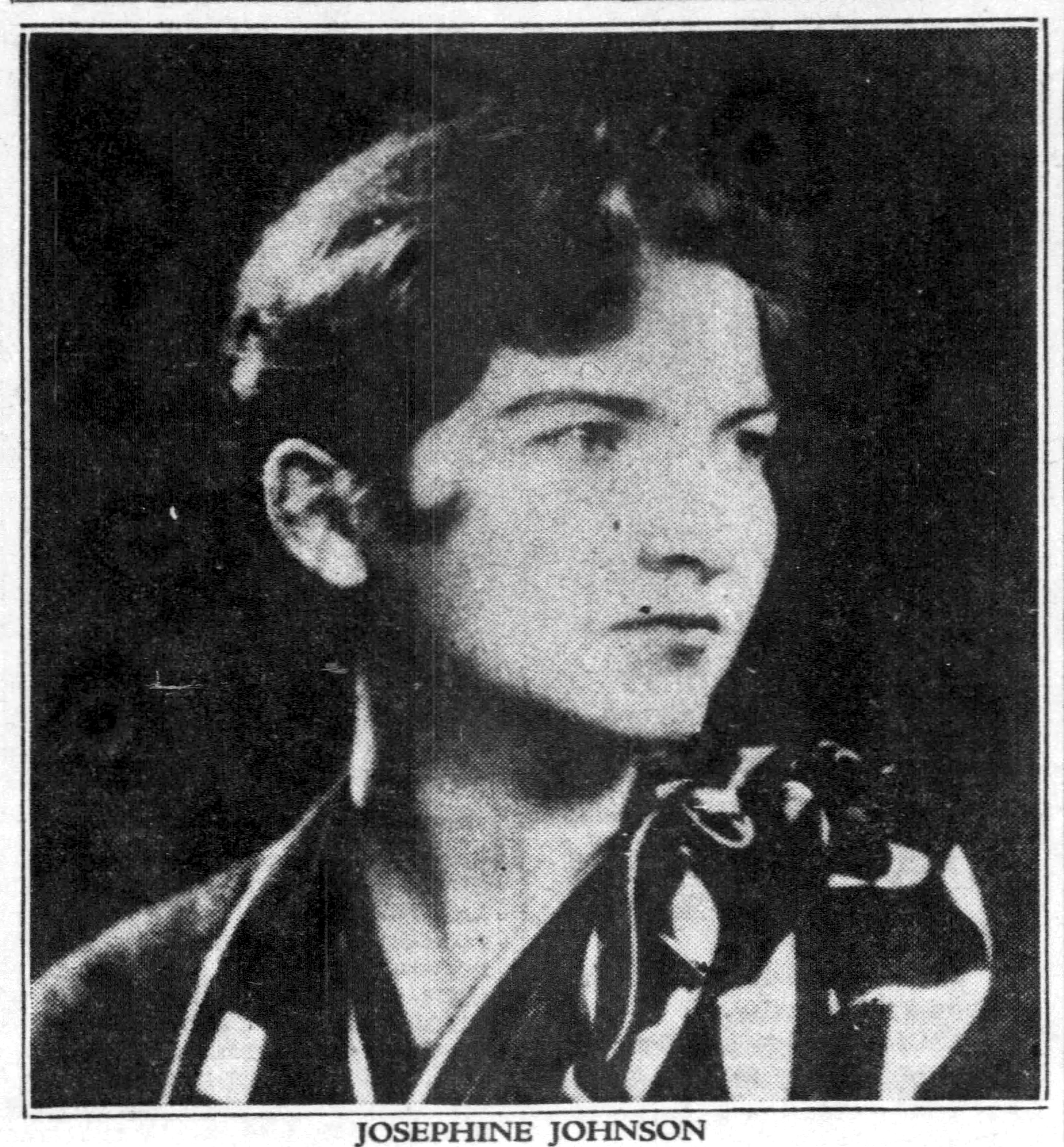
Storming the literary scene as a published award-winning writer, Johnson used her fame to advocate for the working poor in articles she wrote for the St. Louis Post-Dispatch on the 1935 St. Louis gas house workers strike and other causes. Johnson volunteered to paint murals for the St. Louis Mission Free and Turner Schools. She became a member of the American Civil Liberties Union and the Urban League, and served as president of the Co-operative Consumers of St. Louis. In 1939, Johnson helped fellow novelist Fannie Cook to organize the St. Louis Committee for the Rehabilitation of the Sharecroppers, which provided support to evicted Black and white sharecroppers in the Mississippi Delta and Missouri’s Bootheel. Johnson and others, including St. Louis artist Joseph James Jones, were arrested in Forest City, Arkansas, on “suspicion of encouraging cotton field workers to strike, in conjunction with the activities of union workers,” according to an article published in the New York Times on June 6, 1936. The news article reported that Johnson was taken to the courthouse and later released.
In 1939, Johnson married her first husband, Thurlow Smoot, an attorney for the National Labor Relations Board (NLRB) in St. Louis. They had one son before divorcing in 1941. The following year, Johnson married Grant Cannon, a field examiner for the NLRB, and they remained together until his death in 1969. The couple led a relatively quiet life, raising two daughters and Johnson’s son by her previous marriage. For a brief time, they moved to Iowa City, where Johnson taught at the renowned University of Iowa Writers’ Workshop. Cannon became editor of a journal, Farm Quarterly, in 1947, and the family relocated to a farm near Cincinnati, Ohio. Johnson continued to write and to raise her family on their beloved Ohio farm, later recalling those years as the happiest time of her life.
Johnson regarded The Inland Island, originally published in 1969, as her favorite book. In it, she tells about her family’s life and other living species on their Ohio farm, closely observing and detailing a monthly record of nature over the course of a year. She warns about the gradual invasion of a mechanized society and how nature should be preserved. “Appreciate the living,” she advises in the book. “Live the summers now. That’s all you’ll ever have. They’re all anybody will ever have.” The Inland Island has been credited with raising awareness about ecological concerns. The New York Times described it as “a book about nature the way Walden was a book about nature. It should be read by everyone who still retains the capacity to feel anything.”
Johnson lived the rest of her life in Ohio, where she died of pneumonia at the age of seventy-nine. Obituaries appeared in newspapers across the country, including the New York Times, Cincinnati Enquirer, and St. Louis Post-Dispatch. Shortly before her death, Harper Bazaar magazine selected her as one of one hundred women “in touch with our time.” In addition to the Pulitzer Prize, Johnson also received O. Henry Awards for short stories in 1934, 1935, 1942, 1943, and 1944; she was given an honorary Doctor of Humane Letters degree from Washington University in 1970.
Carter, Quentin R. “Josephine W. Johnson and the Pulitzer: The Shaping of a Life.” PhD diss., University of Denver, 1995.
Cuoco, Lorin, and William H. Gass, eds. Literary St. Louis: A Guide. St. Louis: Missouri History Museum, 2000.
Johnson, Josephine W. The Inland Island: A Year in Nature. New York: Simon and Schuster, 1969.
———. Now in November. New York: Simon and Schuster, 1934.
———. Seven Houses: A Memoir of Time and Places. New York: Simon and Schuster, 1973.
"Josephine Johnson and Her Kirkwood Family." Kirkwood Historical Review 7, no. 3 (September 1968): 50–59.
Josephine Johnson Papers. Julian Edison Department of Special Collections, Washington University Libraries. https://aspace.wustl.edu/repositories/6/resources/451
Rattray, Laura. “Josephine Johnson and Clifton Fadiman at Simon and Schuster: The Genesis of a Pulitzer.” Papers of the Bibliographical Society of America 98, no. 2 (June 2004): 209–27.
Published December 10, 2025; Last updated February 2, 2026
Creative Commons Attribution-NonCommerical-ShareAlike 4.0 International (CC BY-NC-SA 4.0)